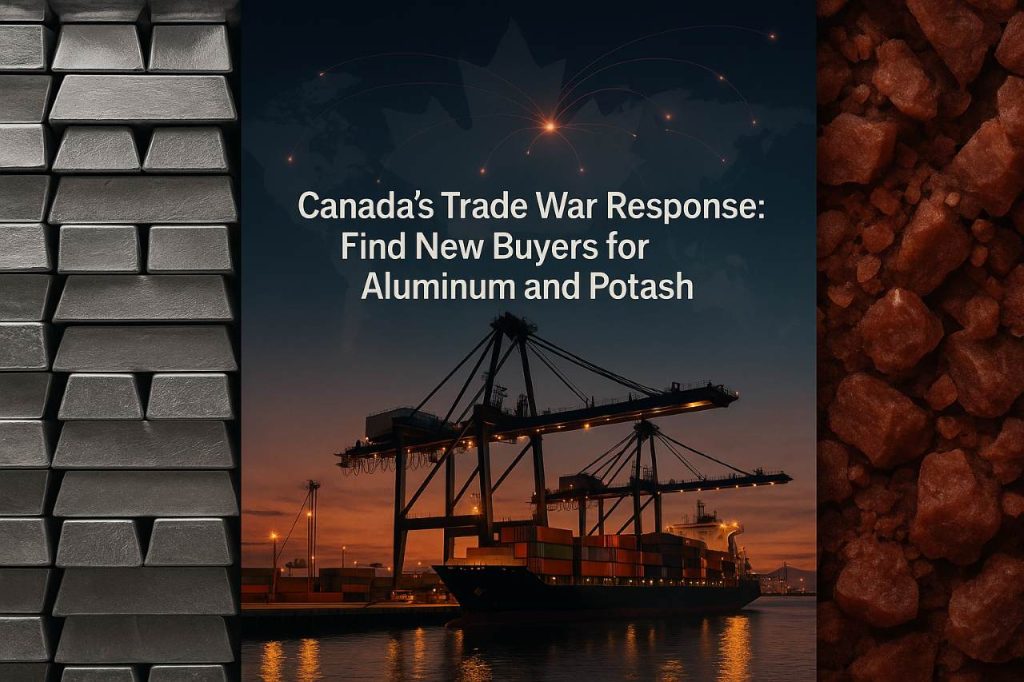
Mark Carney has a $300 billion problem. Three-quarters of Canadian exports flow south to a trading partner that keeps threatening 25% tariffs on everything from steel to softwood lumber. So the Prime Minister is doing what Canadian leaders have talked about for decades: actually diversifying trade away from American dependency.
The strategy centers on two of Canada’s most strategically valuable exports: aluminum from Quebec and potash from Saskatchewan. Both commodities put Canada in a position of unusual leverage. The U.S. needs them, but can’t easily replace Canadian supply. Carney’s government is betting that finding alternative buyers will strengthen Ottawa’s hand in trade negotiations while insulating Canadian industries from Washington’s tariff whiplash.
The Potash Leverage
Here’s a number that should worry American farmers: 85% of U.S. potash imports come from Canada. Potash, a mined mineral essential for fertilizer production, is geographically concentrated. Saskatchewan alone produces roughly a third of global supply. The second-largest supplier to the U.S. market? Russia, at less than 10%.
When President Trump threatened severe tariffs on Canadian fertilizer earlier this month, the math didn’t favor American agriculture. Domestic U.S. potash production is minimal, new mine development takes years, and the deposits simply aren’t there in meaningful quantities. The Fertilizer Institute warned that tariffs would “drive up costs for farmers, which could ultimately be felt at the grocery store by consumers.”
Saskatchewan Premier Scott Moe acknowledged the uncomfortable reality during a recent meeting with U.S. Commerce Secretary Howard Lutnick. Neither Lutnick nor Treasury Secretary Scott Bessent wanted to see fertilizer tariffs that would hurt American farmers. But if Washington persists, Moe noted, Canadian producers would need to find new markets. “They would have to buy it somewhere else, namely Russia would be the option.”
The Carney government is actively working to make that alternative market search a reality. Budget 2025 includes $5 billion for a Trade Diversification Corridors Fund aimed at building infrastructure to reach export markets beyond the U.S. The goal is ambitious: double non-U.S. exports over the next decade, adding roughly $300 billion in new trade.
Aluminum’s Pivot to Europe
The aluminum story is already playing out in real time. U.S. tariffs of 50% on steel and aluminum imports have forced Quebec smelters to find new customers. Data shows Canadian aluminum deliveries to the U.S. fell 22% in the first eight months of 2025 compared to the prior year, a drop of about 410,600 tonnes.
Where is that metal going? Europe. Quebec’s share of production flowing to the U.S. dropped from roughly 95% to 78% between the first and second quarters, while European exports surged. The pivot creates logistical challenges and exposes Canadian producers to European energy prices and longer shipping times. But it demonstrates that alternatives exist when trade relationships sour.
Carney’s government announced new protections for the steel and aluminum industries in July, including restrictions on foreign steel imports and a review of the remission framework to favor Canadian materials in domestic manufacturing. The strategy pairs defense with diversification: protect the industry at home while building pathways to new markets abroad.
The Double-Non-U.S. Gambit
Carney’s October pre-budget address set the target explicitly: double non-U.S. exports within a decade. Given that three-quarters of Canadian merchandise exports currently flow to the United States, the scale of the shift is staggering. Analysts calculate it would require roughly $300 billion in additional trade with markets outside the U.S.
The infrastructure pieces are moving into place. The Major Projects Office, launched in August under CEO Dawn Farrell, has already referred $116 billion in nation-building projects including LNG terminals, critical minerals operations, and new trade corridors. At an ASEAN summit in October, Carney accelerated negotiations on a Canada-ASEAN free trade agreement and announced intent to launch trade deal negotiations with the Philippines.
Canada’s existing trade agreements already show momentum. Exports to Trans-Pacific Partnership members rose 38% to $66 billion in the agreement’s first five years. The Comprehensive Economic and Trade Agreement with the European Union has pushed EU exports to $60 billion annually.
The Strategic Calculation
What makes this moment different from decades of failed diversification rhetoric? The leverage works both ways. Canada supplies 85% of U.S. potash, 80% of U.S. aluminum imports, 60% of U.S. crude oil imports, and 90% of U.S. steel and aluminum imports. These aren’t commodities Washington can easily replace.
The Carney government is using that leverage strategically. By demonstrating willingness to redirect exports to Asia and Europe, Ottawa strengthens its position in CUSMA renegotiations scheduled for 2026. The message to Washington: we’d prefer to keep trading with you, but we have options if you make it too painful.
Whether Canadian industries can execute the pivot remains to be seen. Building port capacity, establishing new trade relationships, and navigating different regulatory environments takes time. But the direction is clear. As Carney told premiers at a December meeting, Canada’s economy must transform “from one that became too reliant on a single trade partner, to one that is resilient and dynamic.”
What This Means for U.S. Business
For American companies dependent on Canadian commodities, the diversification push creates new uncertainty. If Canadian potash producers develop lasting relationships with Asian buyers, U.S. farmers may face tighter supply even after current trade tensions ease. If Quebec aluminum finds permanent homes in European manufacturing, American industrial users will compete with higher prices and longer lead times.
The Trump administration’s tariff strategy assumed Canada would absorb the pain without meaningful alternatives. Carney’s response suggests otherwise. By investing billions in trade infrastructure and aggressively pursuing new agreements, Canada is calling that bluff. The next year of CUSMA negotiations will reveal whether Washington underestimated Ottawa’s leverage, or whether economic integration runs too deep on both sides to fundamentally alter.
