Table of Contents
How Bitcoin fits into today’s financial system is a more interesting story than either its fans or its critics usually tell. On one side, you still hear the liberation narrative: code as constitution, math as monetary policy, no permission required. On the other, Bitcoin is framed as pure casino, a digital slot machine in a world already drowning in risk. Both stories miss something important. Bitcoin has quietly become a small but real part of the way global finance works, not above it and not outside it, but stitched into the same institutions progressives spend so much time worrying about and trying to reform.
This is a political story as much as a technical one. Once an asset touches banks, pension funds, and regulated exchanges, it stops being a self-contained experiment. It becomes something that can move elections, shake credit markets, and alter the balance of power between governments and citizens. The question is not whether Bitcoin will overthrow the system. It is how the system will absorb Bitcoin and what that means for democracy, regulation, and inequality.
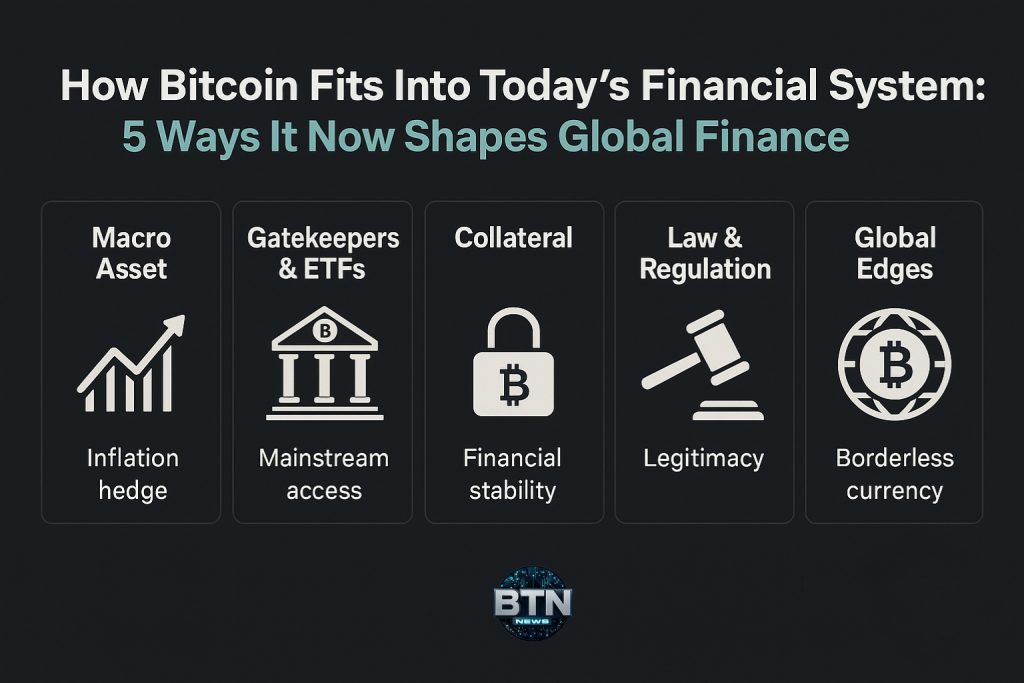
To answer that, it helps to be concrete. Here are five ways Bitcoin now fits into the financial system and why that should matter to anyone who cares about institutions and the rule of law.
1. How Bitcoin Fits Into Today’s Financial System As A Macro Asset
The first way to understand how Bitcoin fits into today’s financial system is as a macro asset. Traders who once rolled their eyes at crypto now keep Bitcoin price charts open alongside Treasury yields and the dollar index. They are not doing this because they suddenly fell in love with cryptography. They are doing it because Bitcoin responds to the same forces that move other high‑beta assets: interest rates, liquidity conditions, and risk appetite.
In low-rate, money-is-cheap environments, Bitcoin tends to behave like a speculative growth stock. When central banks tighten and credit stress rises, it slumps. That is not a sign of purity, but it is a sign of integration. Bitcoin now sits in the mental model of hedge funds and macro desks. It is one more gauge of how easy money feels, one more instrument through which people express views on inflation, technology, or distrust of central banks.
You can see this logic in how investors and traders interact with your own live Bitcoin price chart. They are not just watching a curiosity. They are watching an input into portfolio decisions that involve equities, bonds, and currencies. That is the footprint of a macro asset, not an outsider.
2. How Bitcoin Fits Into Today’s Financial System Through Gatekeepers
The second way Bitcoin fits into the financial system is through the familiar middlemen it once promised to remove. If you ask a corporate treasurer or a retirement fund to hold Bitcoin, they are not downloading a wallet and memorizing a seed phrase. They are calling a custodian, a bank, or an ETF provider.
That institutional wiring looks something like this:
- Regulated custodians hold coins in secure, often multi-signature storage.
- Exchange-traded products wrap Bitcoin exposure in a familiar legal and tax structure.
- Prime brokers and lenders extend leverage and create structured products based on that exposure.
At each step, Bitcoin becomes less like digital cash and more like a raw material in the factory of finance. The same logic that turned mortgages into collateralized debt obligations and volatility into exchange-traded notes is now being applied to Bitcoin. When American Bitcoin’s share price plunged nearly 40 percent after a lock‑up expiry before later stabilizing, it was a reminder that Bitcoin wrapped in traditional vehicles inherits both the reach and the fragility of securities markets.
That tension is worth sitting with. The more Bitcoin plugs into banks and ETFs, the more it becomes subject to exactly the kind of conflicts of interest and opacity progressives critique in traditional finance. The revolution runs through the same old pipes.
3. How Bitcoin Fits Into Today’s Financial System As Collateral
A third way Bitcoin connects to the system is collateral. In crypto-native markets, this is obvious. Traders post Bitcoin to borrow dollars, stablecoins, or other tokens. They stake Bitcoin in derivatives positions and lend it out for yield. When prices fall, they get liquidated. Most of the pain, so far, has been confined to that closed loop.
Yet the line between that loop and the rest of finance is getting blurry. As more institutions hold Bitcoin, they have the option to pledge it against credit lines or structured products. A world in which banks accept Bitcoin as collateral at scale is still hypothetical, but some of the architecture is being built already, often through partnerships between crypto firms and traditional lenders.
The systemic risk question begins here. When an asset is volatile but contained, you can let people make their own mistakes. When an asset becomes widely used as collateral in a system already prone to leverage and short-termism, the story changes. You no longer just have Bitcoin risk. You have feedback loops, margin spirals, and the kind of correlated liquidations that turn market experiments into political crises.
For regulators who lived through 2008, that pattern is uncomfortably familiar. For citizens, it is a reminder that obscure collateral agreements written in conference rooms can end up dictating whether pensions are safe and whether austerity is politically inevitable.
4. How Bitcoin Fits Into Today’s Financial System Through Law And Regulation
The fourth way Bitcoin fits in is legal, not technical. Every jurisdiction that matters is busy deciding whether Bitcoin is a commodity, a security, or something else. Those decisions determine who gets to supervise it, which consumer protections apply, how profits are taxed, and what happens in cross-border disputes.
In the United States, the story has been inconsistent and litigation-heavy. Different agencies have made overlapping claims over digital assets, and much of the real policy is being written in courtrooms as companies challenge enforcement actions. In the European Union, the MiCA framework aims for more predictability on licensing and disclosure, even if national-level implementation still has gaps.
These are not academic fights. Classifying Bitcoin a certain way can either empower watchdogs or leave them under-resourced. It can protect small investors from outright scams or allow a wild-west environment in the name of innovation. It can constrain how banks market Bitcoin-linked products to retail savers, or it can open a path for your grandmother’s pension fund to hold exposure she does not know she has.
From a progressive perspective, the core issue is democratic control. Who sets the rules of the game: elected lawmakers and accountable regulators, or a mix of private exchanges, offshore entities, and corporate lobbyists? Bitcoin’s technical design assumes distrust of states. A healthy financial system needs skepticism of concentrated private power too.
5. How Bitcoin Fits Into Today’s Financial System At The Global Edges
The fifth and perhaps most politically charged way Bitcoin fits into today’s financial system is at its edges. In countries with capital controls, hyperinflation, or authoritarian governments, Bitcoin can operate as a pressure valve. It allows some people to move value across borders without asking permission. It offers a savings instrument that, while volatile, is not at the mercy of a single collapsing currency or a single captured central bank.
There are real stories behind this. Venezuelans using Bitcoin and other digital assets to preserve savings during hyperinflation. Ukrainians and Russians moving funds as sanctions and wartime controls reshaped their financial lives. Activists who accept donations in Bitcoin when bank accounts are frozen. In those contexts, Bitcoin is less a speculative play and more a last resort.
Still, it is important not to romanticize this. Bitcoin’s volatility, the need for reliable internet, and the vulnerability of local on-ramps to state repression all limit what it can do. It is easier to move a few thousand dollars discreetly than to run an entire economy on-chain. Yet even that limited role changes the bargaining power of citizens at the margin. It creates one more lever when governments abuse monetary tools for political gain.
From the perspective of democratic norms, that matters. A world in which every citizen’s savings are trapped inside a weaponized banking system is different from a world where exit is at least possible for some. Bitcoin does not guarantee freedom. It does slightly change the cost of building and maintaining financial repression.
Where Bitcoin Really Sits In The System Now
Put these five pieces together and a more precise picture of how Bitcoin fits into today’s financial system comes into focus.
- It is a macro asset watched by serious investors and traders.
- It is wrapped and intermediated by the same gatekeepers that dominate traditional finance.
- It is starting to function as collateral in ways that could, if left unchecked, magnify systemic risk.
- It is being defined and constrained by legal systems that reflect political choices about fairness, transparency, and power.
- It is a tool, sometimes a fragile one, for people living under financial systems that are not just inefficient but abusive.
Bitcoin has not replaced national currencies in stable democracies. It has not abolished banks. It sits inside the system, not above it. That makes it less dramatic than its white paper origin story, but more important to treat seriously.
For progressives who care about stronger institutions and more equal economies, the choice is not between cheering Bitcoin or banning it. The real choice is whether to let its integration be shaped by the same forces that produced too-big-to-fail banks and opaque derivatives, or to insist on rules that make space for innovation while protecting the people least able to absorb the next crash.
The technology is only half the story. The other half is what courts, parliaments, regulators, and voters decide to do with it. That is where Bitcoin will finally find its place in the financial system, and where the rest of us will live with the consequences.