
Table of Contents
Google Workspace Studio AI agents are Google’s clearest answer to a question every office worker quietly asks by Thursday afternoon: why am I still doing this by hand?
With the general rollout of Google Workspace Studio, Google is turning Gemini 3 into a workbench where anyone can design, build, and deploy AI agents that live directly inside Gmail, Docs, Sheets, Drive, Meet, and Chat. No code. No YAML. Just a prompt and a few clicks. According to Google’s own announcement, early customers have already run more than 20 million tasks through these agents in a single month, from triaging legal notices to managing travel requests and drafting status reports in minutes instead of hours Google Workspace Blog.
The pitch is simple. The implications for power, labor, and democratic oversight are not.
How Google Workspace Studio AI Agents Actually Work
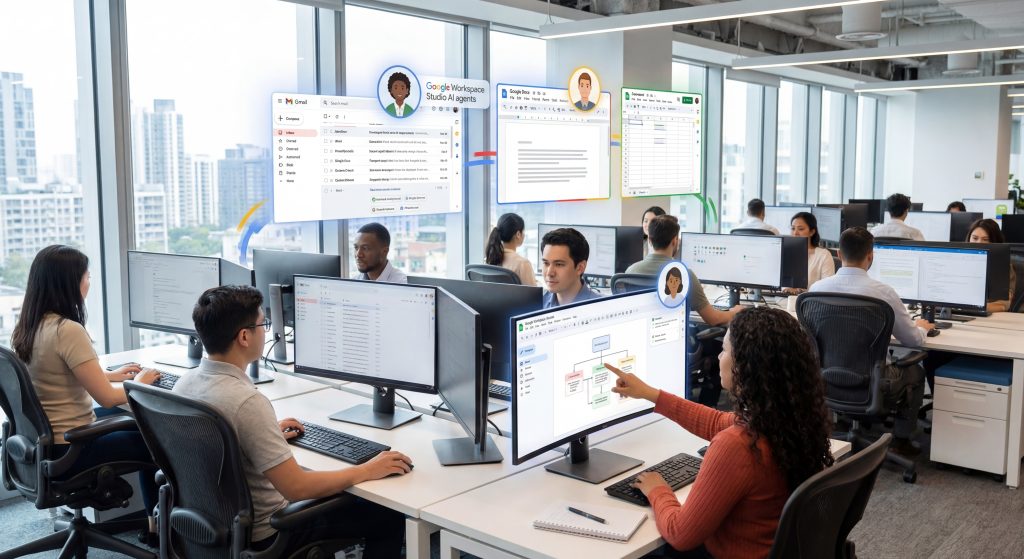
Under the hood, Google Workspace Studio AI agents are Gemini 3 pipelines disguised as friendly workplace helpers. You describe a workflow in plain English and Google turns that description into a live automation that can reason about context, touch multiple apps, and loop in other systems.
A few examples that Google highlights:
- Detect questions in your inbox, label those emails, and ping you in Chat.
- Take meeting notes, extract action items, translate them, and share with the right team.
- Ingest an idea in Chat, route it through a “virtual team” of specialized agents, and output a full user story ready for engineering review.
In one widely touted case, German cleaning solutions company Kärcher built a small constellation of agents to evaluate product ideas. A brainstorming agent evaluates new ideas, a technical agent checks feasibility, a UX agent sketches user flows, and a final agent drafts the user story. The result: internal drafting time dropped by roughly 90 percent, from hours of live meetings and fragmented docs to a two‑minute plan.
This is not just “if this, then that” with better branding. Traditional automation has been brittle and rule-bound, good at moving data from column A to column B but bad at interpreting the messy middle where most real work lives. Gemini-powered Google Workspace Studio AI agents, by contrast, are designed to read your actual documents, interpret sentiment, and adapt to conditions that are hard to predict at design time.
They sit inside the interfaces workers already use. You see agent activity in your Gmail or Drive side panel, tweak logic in a browser tab, and share agents with your colleagues the same way you share a doc.
The Power Shift Inside Organizations
The interesting story here is not “cool new Google feature.” It is who gets to automate what, and under whose rules.
Historically, enterprise automation has been:
- Built by IT, for executives.
- Slow to launch, because every change required a ticket.
- Designed around compliance checkboxes more than workers’ lived reality.
Google Workspace Studio AI agents flip that hierarchy on its head. The people who feel the friction most intensely can now design away their own pain without waiting for a six-month integration project. A support lead can create an agent that drafts responses to customer complaints. A paralegal can instruct an agent to flag unusual clauses in contracts. A school administrator can build a workflow that routes permission slips, tallies responses, and reminds parents.
That is the hopeful version. You can see a quieter, decentralized productivity revolution, where midlevel workers build the tools that management never had time to prioritize.
There is also a darker version. The same tools that let a worker take drudgery off their plate give management a new way to quantify, monitor, and ultimately squeeze that worker. If an agent can triage twice as many emails in an hour, executives will be tempted to ask why the human cannot also respond to twice as many. “Productivity gains” in the spreadsheet become speedups in the body.
We have already seen how AI optimism can feed market expectations. In a recent market wobble, even giants like Nvidia, Meta, and Google themselves watched shares slide as investors tried to square long-term AI narratives with short-term revenue realities, reminding us that the hype cycle cuts both ways for workers and shareholders alike BusinessTech News.
If we treat Google Workspace Studio AI agents as neutral tools, that pressure will be decided unilaterally by executives and boards. If we treat them as part of the social infrastructure of work, then unions, regulators, and workers themselves have a legitimate claim on how they are deployed.
AI Agents, Data Governance, And Democratic Norms
Progressive politics tends to care about the big, noisy fights: elections, courts, visible censorship. Google Workspace Studio AI agents are quieter. They shape who sees which email first, whose complaint gets escalated, which applicant looks like a risky hire. Yet in a heavily digitized workplace, those are democratic questions too.
Three risks stand out.
- Opacity of automated decisions.
If a Google Workspace Studio AI agent flags certain messages as “high priority” or routes contracts into different review queues, workers deserve to know how that logic is built and audited. Black-box automation inside HR, compliance, or legal can become a backdoor to discrimination or soft political retaliation. - Centralization of workplace intelligence.
These agents sit atop Gmail, Docs, Sheets, and Chat, which already hold the institutional memory of many organizations. As agents are trained and tuned on that data, the learned playbooks of entire teams are effectively bottled inside a proprietary system owned by one company, in one jurisdiction. That is a concentration of power that should bother anyone who cares about institutional pluralism. - Erosion of professional judgment.
If you grow up in an organization where the AI agent always drafts your responses and structures your day, you slowly lose the muscle tone of discretion. It becomes harder to resist a bad instruction, to spot a pattern the AI did not see, or to say, “this should not be automated at all.” For democratic societies, which rely on millions of small acts of dissent and prudence, that erosion is not a small thing.
To its credit, Google has at least committed that data processed through Studio is not used to train general models outside a customer’s domain and is constrained by existing access controls. That is good as far as it goes. It does not solve the larger structural question of whether a single platform should be allowed to intermediate so much of day-to-day decision-making for schools, hospitals, NGOs, city governments, and small businesses.
Regulators who worry about app stores and ad markets should extend that concern to “agent stores” too.
What A Responsible Rollout Of Google Workspace Studio AI Agents Would Look Like
It is tempting to frame this as a binary: embrace automation or get left behind. That framing is a choice, and it mostly serves vendors and investors.
A healthier approach to Google Workspace Studio AI agents would do at least four things.
- Bake worker voice into deployment.
Before a large organization rolls out agents that touch scheduling, evaluation, or discipline, there should be a structured consultation with workers and, where they exist, unions. Which tasks are fair game for automation? Which are core to professional identity and should remain human? - Mandate algorithmic transparency inside the org.
Every agent that has material impact on workloads, pay, performance reviews, or access to benefits should be documented. Workers deserve a plain-language explanation of what the agent does, what data it sees, and how to appeal its mistakes. - Require internal “kill switches.”
It should be easy for designated human owners to pause or roll back agents that generate harmful effects, even if those effects are subtle. No one should have to open a ticket with Google to stop an internal automation that is misbehaving. - Invest in public-interest alternatives.
Governments and large NGOs have a clear interest in open-source or at least non-monopoly frameworks for workplace agents. Otherwise, in a crisis, vast slices of the public sector will effectively be downstream of one commercial roadmap.
None of this means refusing to use Google Workspace Studio AI agents. It means treating them as civic infrastructure, not just office toys.
The Next Labor Platform Fight Is Already Here
If the 2010s were about social platforms reshaping public discourse, the late 2020s will be about labor platforms reshaping work from the inside out. Google Workspace Studio AI agents are early evidence. They will not be the last.
Used well, they can hand boring, repetitive tasks to software and give humans more time for care, creativity, and actual judgment. Used poorly, they can intensify burnout, obscure responsibility, and centralize power in ways that make workplaces more brittle and less democratic.
The technology is real, and impressive. The open question is whether institutions that adopt it will be equally ambitious about governance, worker protections, and public accountability.
That is a design problem too. And we should be at least as creative about solving it as Google has been about building its agents.