ETFs
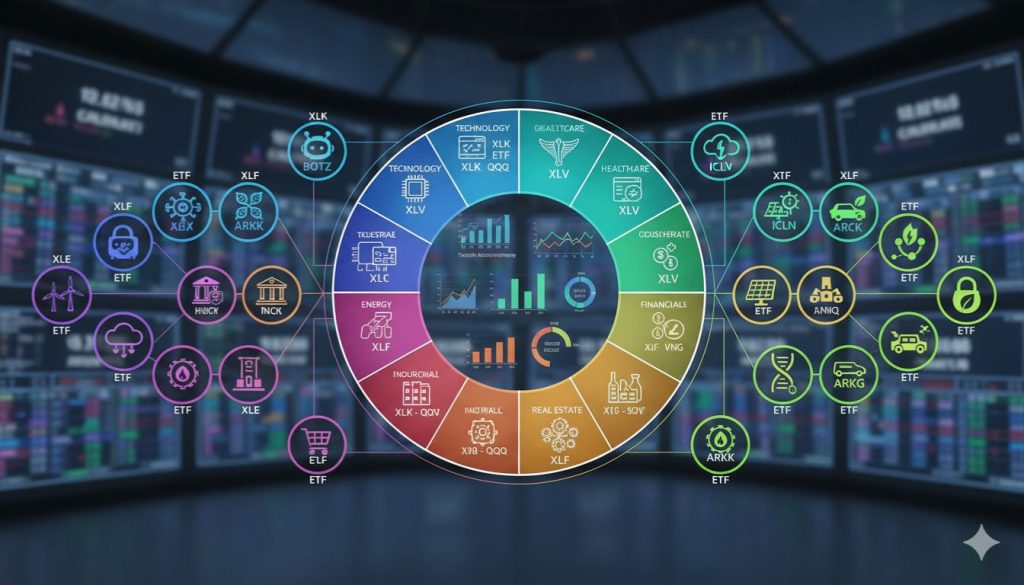
Funds & ETFs: Your Complete Guide to Investment Funds
Instant Diversification, Professional Management, Low-Cost Investing
Investment funds pool money from multiple investors to purchase diversified portfolios of stocks, bonds, commodities, or other assets. From traditional mutual funds to modern ETFs (Exchange-Traded Funds), these vehicles offer instant diversification, professional management, and access to strategies that would be difficult for individual investors to replicate. Whether you’re seeking broad market exposure through index funds, tactical sector plays, or specialized strategies like dividend growth or ESG investing, funds and ETFs are the building blocks of modern portfolios. With over $10 trillion in ETF assets alone and trillions more in mutual funds, these investment vehicles have democratized access to sophisticated investment strategies for investors of all sizes.
What Are Investment Funds?
Investment funds are pooled investment vehicles that combine money from multiple investors to purchase a diversified portfolio of securities.
Key Characteristics:
- Instant Diversification: Single purchase provides exposure to dozens or thousands of securities
- Professional Management: Investment professionals (or algorithms) manage the portfolio
- Economies of Scale: Lower costs through pooled resources
- Liquidity: Easy to buy and sell (especially ETFs)
- Transparency: Regular disclosure of holdings
- Accessibility: Low minimum investments for most funds
Two Main Types:
- Mutual Funds: Priced once daily, purchased directly from fund company
- ETFs: Trade throughout the day like stocks on exchanges
Why Invest in Funds?
- Simplicity: One investment provides broad exposure
- Risk Reduction: Diversification reduces individual security risk
- Cost Efficiency: Lower fees than buying individual securities
- Time Savings: No need to research individual stocks/bonds
- Access: Exposure to markets or strategies otherwise difficult to access
- Tax Efficiency: ETFs especially tax-efficient
ETFs vs. Mutual Funds
🔄 Key Differences
| Feature | ETFs | Mutual Funds |
|---|---|---|
| Trading | Trade all day like stocks | Priced once daily at close |
| Minimum Investment | 1 share (often $50-500) | Often $1,000-3,000 minimum |
| Expense Ratios | Typically lower (0.03%-0.75%) | Higher (0.50%-2.00%+) |
| Tax Efficiency | Very tax-efficient | Less tax-efficient |
| Purchase Method | Through brokerage account | Direct from fund company or broker |
| Commissions | May pay trading commission | No commission typically |
| Active Management | Mostly passive index-tracking | More actively managed options |
| Intraday Trading | Yes – limit orders, stop losses | No – end-of-day pricing only |
| Transparency | Daily holdings disclosure | Quarterly holdings disclosure |
When to Choose ETFs:
- Want intraday trading flexibility
- Prefer tax efficiency
- Lower minimum investment needs
- Passive index investing focus
When to Choose Mutual Funds:
- Prefer automatic investments (dollar-cost averaging)
- Want active management options
- No access to commission-free ETF trading
- Investing in 401(k) or workplace plan
Index Funds vs. Active Funds
📊 Investment Philosophy
Index Funds (Passive Management):
- Track a market index (S&P 500, Total Stock Market, etc.)
- Rules-based, automatic rebalancing
- Very low fees (0.03%-0.20% typical)
- Tax-efficient
- Consistently match market performance
- Philosophy: “You can’t beat the market, so match it cheaply”
Active Funds:
- Professional managers try to beat the market
- Security selection and market timing
- Higher fees (0.50%-2.00%+ typical)
- Less tax-efficient
- Seek to outperform benchmarks
- Philosophy: “Skilled managers can identify opportunities and outperform”
The Evidence:
- Over 90% of active funds underperform their benchmarks over 15 years (after fees)
- Index funds have won the performance race for most investors
- Few active managers consistently outperform
Best Use Cases for Active Funds:
- Inefficient markets (small-cap, international, emerging markets)
- Specialized strategies (long-short, market-neutral)
- Tax-loss harvesting and customization
- Access to exceptional managers (rare)
Broad Market Index Funds & ETFs
🌐 Total Market Exposure
The foundation of most portfolios—broad, diversified, low-cost index funds tracking entire markets.
U.S. Total Stock Market
Largest and Most Popular:
Vanguard Total Stock Market (VTI)
- Tracks CRSP U.S. Total Market Index
- 3,600+ holdings covering entire U.S. stock market
- Expense ratio: 0.03%
- Market cap weighted (large, mid, small-cap)
- Monthly searches: 450,000+
Vanguard Total Stock Market Index Fund (VTSAX)
- Mutual fund version of VTI
- $3,000 minimum investment
- Same holdings and performance
- Ideal for automatic investments
Alternatives:
- ITOT (iShares Core S&P Total U.S. Stock Market): 0.03% fee
- SPTM (SPDR Portfolio S&P 1500): 0.03% fee
- SCHB (Schwab U.S. Broad Market): 0.03% fee
View Total Market Funds Performance →
S&P 500 Index Funds
Tracks 500 largest U.S. companies:
SPY (SPDR S&P 500 ETF Trust)
- First ETF ever created (1993)
- Most liquid ETF in the world
- Higher expense ratio: 0.09%
- Preferred by traders
- Daily volume: 80+ million shares
VOO (Vanguard S&P 500 ETF)
- Lower expense ratio: 0.03%
- Tax-efficient
- Preferred by long-term investors
- AUM: $400+ billion
IVV (iShares Core S&P 500 ETF)
- Expense ratio: 0.03%
- BlackRock backing
- Excellent liquidity
Mutual Fund Version:
- VFIAX (Vanguard 500 Index Fund Admiral): 0.04% fee, $3,000 minimum
View S&P 500 Fund Performance →
International Stock Funds
Total International:
VXUS (Vanguard Total International Stock)
- 8,000+ holdings from 40+ countries
- Developed and emerging markets
- Expense ratio: 0.08%
- Complements U.S. stock exposure
IXUS (iShares Core MSCI Total International)
- Similar coverage to VXUS
- Expense ratio: 0.07%
- Slightly different index methodology
Developed Markets Only:
VEA (Vanguard FTSE Developed Markets)
- Excludes emerging markets
- Europe, Japan, UK, Canada, Australia
- Expense ratio: 0.05%
EFA (iShares MSCI EAFE)
- Europe, Australasia, Far East
- Excludes Canada
- Expense ratio: 0.32%
Emerging Markets:
VWO (Vanguard FTSE Emerging Markets)
- China, India, Taiwan, Brazil, etc.
- Higher growth potential, higher volatility
- Expense ratio: 0.08%
IEMG (iShares Core MSCI Emerging Markets)
- Similar to VWO
- Expense ratio: 0.09%
View International Fund Performance →
Total Bond Market Funds
U.S. Aggregate Bonds:
AGG (iShares Core U.S. Aggregate Bond)
- Most popular bond ETF
- Investment-grade U.S. bonds
- Treasuries, corporates, munis
- Expense ratio: 0.03%
BND (Vanguard Total Bond Market)
- Similar to AGG
- Expense ratio: 0.03%
- Vanguard’s bond flagship
SCHZ (Schwab U.S. Aggregate Bond)
- Lower expense ratio: 0.03%
- Broad bond exposure
Target-Date / Lifecycle Funds
Automatically adjust allocation based on retirement date:
Vanguard Target Retirement Funds:
- VTTVX: Target 2025
- VFIFX: Target 2050
- VTTSX: Target 2060
- Gradually shift from stocks to bonds as target date approaches
- All-in-one solution
- Expense ratios: 0.08%
Fidelity Freedom Funds:
- Similar concept
- Slightly higher fees
- More actively managed
When to Use:
- 401(k) investing
- Set-it-and-forget-it approach
- Don’t want to manage allocation
- Single fund solution
Sector & Industry ETFs
🏭 Targeted Exposure to Specific Industries
Sector funds allow tactical overweighting or playing economic themes.
Technology Sector
XLK (Technology Select Sector SPDR)
- Apple, Microsoft, Nvidia largest holdings
- Hardware, software, semiconductors
- Expense ratio: 0.10%
VGT (Vanguard Information Technology)
- Broader tech exposure
- Expense ratio: 0.10%
QQQ (Invesco QQQ Trust)
- Tracks Nasdaq-100
- Tech-heavy but includes other sectors
- Expense ratio: 0.20%
SOXX (iShares Semiconductor ETF)
- Pure semiconductor play
- Nvidia, AMD, Intel, TSMC
- Higher volatility
- Expense ratio: 0.35%
View Technology Sector Performance →
Healthcare Sector
XLV (Health Care Select Sector SPDR)
- Pharmaceuticals, biotech, equipment
- Defensive sector characteristics
- Expense ratio: 0.10%
VHT (Vanguard Health Care ETF)
- Similar to XLV
- Expense ratio: 0.10%
IBB (iShares Biotechnology ETF)
- Pure biotech play
- Higher risk/reward
- Expense ratio: 0.45%
View Healthcare Sector Performance →
Financial Sector
XLF (Financial Select Sector SPDR)
- Banks, insurance, investment firms
- Interest rate sensitive
- Expense ratio: 0.10%
VFH (Vanguard Financials ETF)
- Broad financial exposure
- Expense ratio: 0.10%
KRE (SPDR S&P Regional Banking ETF)
- Regional and community banks
- More economic sensitivity
- Expense ratio: 0.35%
View Financial Sector Performance →
Energy Sector
XLE (Energy Select Sector SPDR)
- Oil & gas companies
- ExxonMobil, Chevron top holdings
- Expense ratio: 0.10%
VDE (Vanguard Energy ETF)
- Similar energy exposure
- Expense ratio: 0.10%
XOP (SPDR S&P Oil & Gas Exploration)
- Smaller exploration companies
- More volatile
- Expense ratio: 0.35%
View Energy Sector Performance →
Real Estate Sector (REITs)
VNQ (Vanguard Real Estate ETF)
- Diversified REIT exposure
- Commercial, residential, industrial
- Expense ratio: 0.12%
IYR (iShares U.S. Real Estate ETF)
- Similar REIT coverage
- Expense ratio: 0.40%
XLRE (Real Estate Select Sector SPDR)
- S&P 500 real estate sector
- Expense ratio: 0.10%
View Real Estate Sector Performance →
Consumer Discretionary
XLY (Consumer Discretionary Select Sector SPDR)
- Amazon, Tesla, Home Depot
- Economic growth sensitive
- Expense ratio: 0.10%
Consumer Staples
XLP (Consumer Staples Select Sector SPDR)
- Procter & Gamble, Coca-Cola, Walmart
- Defensive sector
- Expense ratio: 0.10%
Industrials
XLI (Industrial Select Sector SPDR)
- Manufacturing, aerospace, transportation
- Economic cycle sensitive
- Expense ratio: 0.10%
Utilities
XLU (Utilities Select Sector SPDR)
- Electric, gas, water utilities
- Defensive, high dividend
- Expense ratio: 0.10%
Materials
XLB (Materials Select Sector SPDR)
- Chemicals, metals, mining
- Commodity exposure
- Expense ratio: 0.10%
Communication Services
XLC (Communication Services Select Sector SPDR)
- Meta, Alphabet, Netflix
- Media and telecom
- Expense ratio: 0.10%
Strategy & Factor ETFs
📈 Systematic Investing Approaches
Factor-based and strategy ETFs target specific characteristics shown to outperform over time.
Value Investing
VTV (Vanguard Value ETF)
- Large-cap value stocks
- Lower P/E, higher dividends
- Expense ratio: 0.04%
IVE (iShares S&P 500 Value ETF)
- S&P 500 value subset
- Expense ratio: 0.18%
VBR (Vanguard Small-Cap Value)
- Small-cap value
- Historical outperformance
- Expense ratio: 0.07%
Growth Investing
VUG (Vanguard Growth ETF)
- Large-cap growth stocks
- Higher valuations, faster growth
- Expense ratio: 0.04%
IVW (iShares S&P 500 Growth ETF)
- S&P 500 growth subset
- Expense ratio: 0.18%
Dividend Funds
VYM (Vanguard High Dividend Yield)
- High-yielding U.S. stocks
- Yield: 2.5-3.5%
- Expense ratio: 0.06%
SCHD (Schwab U.S. Dividend Equity)
- Dividend growth focus
- Quality screen
- Expense ratio: 0.06%
- Very popular with income investors
DGRO (iShares Core Dividend Growth)
- Companies growing dividends
- Expense ratio: 0.08%
VIG (Vanguard Dividend Appreciation)
- 10+ years dividend growth
- Quality companies
- Expense ratio: 0.06%
NOBL (ProShares S&P 500 Dividend Aristocrats)
- 25+ years consecutive dividend increases
- Only 65 holdings (exclusive club)
- Expense ratio: 0.35%
View Dividend Fund Performance →
Quality Factor
QUAL (iShares MSCI USA Quality Factor)
- High ROE, stable earnings, low debt
- Quality screen
- Expense ratio: 0.15%
Momentum
MTUM (iShares MSCI USA Momentum Factor)
- Stocks with strong recent performance
- Trend following
- Expense ratio: 0.15%
Low Volatility
USMV (iShares MSCI USA Min Vol Factor)
- Lower volatility stocks
- Defensive positioning
- Expense ratio: 0.15%
SPLV (Invesco S&P 500 Low Volatility)
- 100 lowest volatility S&P 500 stocks
- Expense ratio: 0.25%
Small-Cap & Mid-Cap
VB (Vanguard Small-Cap ETF)
- Broad small-cap exposure
- Higher growth potential
- Expense ratio: 0.05%
IJR (iShares Core S&P Small-Cap)
- S&P SmallCap 600 Index
- Expense ratio: 0.06%
VO (Vanguard Mid-Cap ETF)
- Mid-cap exposure
- Sweet spot for growth
- Expense ratio: 0.04%
International & Emerging Market Funds
🌏 Global Diversification
Developed International Markets
VEA (Vanguard FTSE Developed Markets)
- Europe, Japan, UK, Canada
- Expense ratio: 0.05%
IEFA (iShares Core MSCI EAFE)
- Similar developed market coverage
- Expense ratio: 0.07%
Europe
VGK (Vanguard FTSE Europe ETF)
- European stocks only
- UK, France, Germany, Switzerland
- Expense ratio: 0.08%
EZU (iShares MSCI Eurozone ETF)
- Eurozone countries only
- Expense ratio: 0.51%
Asia Pacific
VPL (Vanguard FTSE Pacific ETF)
- Japan, Australia, Hong Kong
- Expense ratio: 0.08%
Japan
EWJ (iShares MSCI Japan ETF)
- Pure Japan exposure
- Expense ratio: 0.50%
China
FXI (iShares China Large-Cap ETF)
- Chinese large-caps
- Alibaba, Tencent (via ADRs)
- Expense ratio: 0.74%
MCHI (iShares MSCI China ETF)
- Broader China exposure
- Expense ratio: 0.57%
KWEB (KraneShares CSI China Internet ETF)
- Chinese internet/tech companies
- Volatile but high growth
- Expense ratio: 0.68%
India
INDA (iShares MSCI India ETF)
- Fast-growing economy
- Expense ratio: 0.64%
Emerging Markets
VWO (Vanguard FTSE Emerging Markets)
- Broad emerging market exposure
- China, Taiwan, India, Brazil
- Expense ratio: 0.08%
IEMG (iShares Core MSCI Emerging Markets)
- Similar EM coverage
- Expense ratio: 0.09%
EEM (iShares MSCI Emerging Markets)
- Older, more established EM ETF
- Higher expense ratio: 0.68%
View International Fund Performance →
Fixed Income & Bond ETFs
💰 Income and Stability
Treasury ETFs
SHY (iShares 1-3 Year Treasury Bond)
- Short-term Treasuries
- Very low volatility
- Expense ratio: 0.15%
IEF (iShares 7-10 Year Treasury)
- Intermediate Treasuries
- Expense ratio: 0.15%
TLT (iShares 20+ Year Treasury Bond)
- Long-term Treasuries
- High interest rate sensitivity
- Expense ratio: 0.15%
Corporate Bond ETFs
LQD (iShares iBoxx Investment Grade Corporate)
- Investment-grade corporate bonds
- Expense ratio: 0.14%
HYG (iShares iBoxx High Yield Corporate)
- High-yield (junk) bonds
- Higher risk, higher yield
- Expense ratio: 0.49%
JNK (SPDR Bloomberg High Yield Bond)
- Alternative high-yield exposure
- Expense ratio: 0.40%
Municipal Bond ETFs
MUB (iShares National Muni Bond)
- Tax-exempt municipal bonds
- Expense ratio: 0.05%
VTEB (Vanguard Tax-Exempt Bond)
- Similar muni exposure
- Expense ratio: 0.05%
International Bond ETFs
BNDX (Vanguard Total International Bond)
- Non-U.S. investment-grade bonds
- Currency hedged version available
- Expense ratio: 0.08%
Commodity & Alternative ETFs
🥇 Beyond Stocks and Bonds
Gold & Precious Metals
GLD (SPDR Gold Shares)
- Physical gold-backed
- Most liquid gold ETF
- Expense ratio: 0.40%
IAU (iShares Gold Trust)
- Similar to GLD, lower fees
- Expense ratio: 0.25%
SLV (iShares Silver Trust)
- Physical silver-backed
- Expense ratio: 0.50%
GDX (VanEck Gold Miners ETF)
- Gold mining companies
- Leveraged gold exposure
- Expense ratio: 0.51%
Broad Commodities
DBC (Invesco DB Commodity Index)
- Diversified commodity exposure
- Energy, agriculture, metals
- Expense ratio: 0.87%
GSG (iShares S&P GSCI Commodity-Indexed Trust)
- Broad commodity index
- Energy-heavy weighting
- Expense ratio: 0.75%
Oil & Energy Commodities
USO (United States Oil Fund)
- Crude oil futures exposure
- Volatile, contango issues
- Expense ratio: 0.79%
UNG (United States Natural Gas Fund)
- Natural gas futures
- Very volatile
- Expense ratio: 1.06%
Real Estate (REITs)
VNQ (Vanguard Real Estate ETF)
- Diversified REIT exposure
- Expense ratio: 0.12%
View Commodity ETF Performance →
Cryptocurrency & Digital Asset ETFs
₿ Regulated Crypto Exposure
Bitcoin ETFs
IBIT (iShares Bitcoin Trust)
- Direct Bitcoin exposure
- Spot Bitcoin holdings
- Expense ratio: 0.25%
FBTC (Fidelity Wise Origin Bitcoin Fund)
- Fidelity’s spot Bitcoin ETF
- Expense ratio: 0.25%
GBTC (Grayscale Bitcoin Trust)
- Oldest Bitcoin product
- Higher fees
- Expense ratio: 1.50%
Ethereum ETFs
ETHA (iShares Ethereum Trust)
- Spot Ethereum exposure
- Expense ratio: 0.25%
Crypto Strategy ETFs
BITO (ProShares Bitcoin Strategy ETF)
- Bitcoin futures (not spot)
- Contango drag
- Expense ratio: 0.95%
Thematic & Innovation ETFs
🚀 Investing in Tomorrow’s Trends
Thematic ETFs focus on long-term structural trends and innovations.
Artificial Intelligence & Technology
ARKK (ARK Innovation ETF)
- Disruptive innovation
- Active management by Cathie Wood
- High volatility
- Expense ratio: 0.75%
BOTZ (Global X Robotics & AI ETF)
- Robotics and AI companies
- Expense ratio: 0.68%
ROBT (First Trust Nasdaq AI & Robotics)
- AI and automation
- Expense ratio: 0.65%
Clean Energy & ESG
ICLN (iShares Global Clean Energy)
- Renewable energy companies
- Solar, wind, battery
- Expense ratio: 0.42%
TAN (Invesco Solar ETF)
- Pure solar play
- Expense ratio: 0.69%
ESGU (iShares MSCI USA ESG Select)
- ESG-screened U.S. stocks
- Expense ratio: 0.15%
Cybersecurity
HACK (ETFMG Prime Cyber Security)
- Cybersecurity companies
- Expense ratio: 0.60%
CIBR (First Trust NASDAQ Cybersecurity)
- Alternative cyber exposure
- Expense ratio: 0.60%
Cloud Computing
SKYY (First Trust Cloud Computing)
- Cloud infrastructure and services
- Expense ratio: 0.60%
Genomics & Biotech
ARKG (ARK Genomic Revolution)
- Gene editing, CRISPR, biotech
- Expense ratio: 0.75%
Space Exploration
UFO (Procure Space ETF)
- Space economy companies
- Expense ratio: 0.75%
E-Commerce
EBIZ (Global X E-commerce ETF)
- Online retail and platforms
- Expense ratio: 0.50%
Electric Vehicles
DRIV (Global X Autonomous & Electric Vehicles)
- EV and autonomous driving
- Expense ratio: 0.68%
KARS (KraneShares Electric Vehicles)
- EV manufacturers and suppliers
- Expense ratio: 0.70%
View Thematic ETF Performance →
Leveraged & Inverse ETFs
⚡ Amplified Returns (and Risks)
WARNING: These are short-term trading tools, not buy-and-hold investments. Daily rebalancing causes volatility decay.
Leveraged Long (2x-3x)
TQQQ (ProShares UltraPro QQQ)
- 3x daily Nasdaq-100 returns
- Extremely volatile
- Expense ratio: 0.86%
UPRO (ProShares UltraPro S&P 500)
- 3x daily S&P 500 returns
- Expense ratio: 0.91%
SSO (ProShares Ultra S&P 500)
- 2x daily S&P 500 returns
- Expense ratio: 0.90%
Inverse (Short/Bear)
SH (ProShares Short S&P 500)
- -1x daily S&P 500 returns
- Profit from declines
- Expense ratio: 0.89%
SQQQ (ProShares UltraPro Short QQQ)
- -3x daily Nasdaq-100 returns
- Extreme volatility
- Expense ratio: 0.95%
Sector Leveraged
SOXL (Direxion Daily Semiconductor Bull 3X)
- 3x daily semiconductor returns
- Expense ratio: 0.94%
CURE (Direxion Daily Healthcare Bull 3X)
- 3x daily healthcare returns
- Expense ratio: 0.95%
Risks of Leveraged/Inverse ETFs:
- Volatility decay over time
- Not for holding periods > 1 day
- Can lose money even if direction correct over time
- Extremely high risk
View Leveraged ETF Performance (Use with Caution) →
Active ETFs & Smart Beta
🎯 Active Management in ETF Wrapper
Active Equity ETFs
ARKK (ARK Innovation)
- Actively managed disruptive innovation
- Cathie Wood portfolio manager
- Expense ratio: 0.75%
DSTL (Distillate U.S. Fundamental Stability & Value)
- Quantitative value strategy
- Expense ratio: 0.39%
Smart Beta / Strategic Beta
RPG (Invesco S&P 500 Pure Growth)
- Growth factor tilt
- Expense ratio: 0.35%
RPV (Invesco S&P 500 Pure Value)
- Value factor tilt
- Expense ratio: 0.35%
USMV (iShares MSCI USA Min Vol)
- Minimum volatility strategy
- Expense ratio: 0.15%
Fund Providers & Families
🏢 Major Fund Companies
Vanguard
- Pioneer of index investing (founded by John Bogle)
- Lowest expense ratios
- Investor-owned structure
- Popular funds: VTI, VOO, VXUS, BND, VYM
BlackRock (iShares)
- World’s largest asset manager
- Most extensive ETF lineup
- Popular funds: AGG, IVV, EFA, LQD, GLD
State Street (SPDR)
- Created first U.S. ETF (SPY)
- Sector ETFs (XLK, XLF, XLE, etc.)
- Popular funds: SPY, GLD, XLK, XLF
Schwab
- Extremely low-cost options
- Integrated with brokerage platform
- Popular funds: SCHD, SCHX, SCHA, SCHB
Invesco
- QQQ flagship product
- Specialized and thematic funds
- Popular funds: QQQ, QQQM, RSP
ARK Invest
- Actively managed innovation focus
- Cathie Wood leadership
- High volatility
- Popular funds: ARKK, ARKG, ARKF
ProShares
- Leveraged and inverse ETFs
- Alternative strategies
- Popular funds: TQQQ, UPRO, SH
VanEck
- Specialized sector funds
- International expertise
- Popular funds: GDX, VGK, EEM
📚 Fund & ETF Education
For Beginners
Getting Started:
- What is an ETF? How do they work?
- ETF vs. mutual fund: Which is right for you?
- How to buy ETFs (brokerage accounts, commission-free trading)
- Understanding expense ratios and total cost
- Building a simple 3-fund portfolio
- Dollar-cost averaging with ETFs
Core Concepts:
- What is an index fund?
- Market cap weighting explained
- Tracking error and tracking difference
- NAV vs. market price
- Creation and redemption mechanism
- Bid-ask spreads and liquidity
For Intermediate Investors
Portfolio Construction:
- Asset allocation strategies
- Core and satellite approach
- Portfolio rebalancing
- Tax-loss harvesting with ETFs
- Dividend reinvestment strategies
- International allocation recommendations
Fund Analysis:
- How to read fund fact sheets
- Comparing similar ETFs (overlap analysis)
- Understanding holdings and sector exposures
- Performance attribution
- Risk-adjusted returns (Sharpe ratio, etc.)
- When to use active vs. passive
For Advanced Investors
Advanced Strategies:
- Factor investing deep-dive
- Smart beta implementation
- Momentum and trend following
- Tactical asset allocation
- Leveraged ETF strategies (trading only)
- Options strategies on ETFs
- Portfolio optimization techniques
Technical Details:
- ETF arbitrage mechanism
- Securities lending in ETFs
- Premium/discount to NAV
- Tax efficiency mechanisms
- Fund closure and merger considerations
- Regulatory environment (40 Act vs. ETPs)
📊 Fund Research & Analysis Tools
Screening Tools
Screen by:
- Asset class (stocks, bonds, commodities, alternatives)
- Geography (U.S., international, emerging)
- Sector or industry
- Expense ratio
- AUM (assets under management)
- Average volume and liquidity
- Performance metrics
- Dividend yield
Comparison Tools
Compare:
- Holdings overlap between funds
- Performance over various timeframes
- Risk metrics (volatility, max drawdown, beta)
- Expense ratios and costs
- Tax efficiency
- Tracking error vs. index
Portfolio Analysis
Analyze your portfolio:
- Total expense ratio across all holdings
- Asset allocation breakdown
- Sector exposure
- Geographic exposure
- Factor tilts
- Overlap and redundancy
- Diversification score
🔔 Real-Time Fund Data
What We Provide:
- Live Prices: Real-time ETF prices and quotes
- Performance: Daily, weekly, monthly, yearly returns
- Holdings: Top 10 holdings and full portfolio disclosure
- Flows: Daily fund flows (money in/out)
- Premiums/Discounts: NAV vs. market price
- Dividend Distributions: Ex-dates and payment amounts
- News: Fund-specific news and manager commentary
- Comparison Charts: Side-by-side performance visualization
💡 Sample Portfolio Models
Conservative (Capital Preservation)
- 20% U.S. stocks (VOO or VTI)
- 10% International stocks (VXUS)
- 60% Bonds (AGG or BND)
- 10% Cash/Short-term Treasuries (SHY)
Moderate (Balanced Growth)
- 40% U.S. stocks (VTI)
- 20% International stocks (VXUS)
- 35% Bonds (AGG)
- 5% REITs (VNQ)
Aggressive (Growth)
- 60% U.S. stocks (VTI)
- 30% International stocks (VXUS)
- 10% Bonds (AGG)
Income-Focused
- 30% Dividend stocks (SCHD, VYM)
- 30% REITs (VNQ)
- 30% Corporate bonds (LQD)
- 10% High-yield bonds (HYG)
Three-Fund Portfolio (Bogleheads Classic)
- 40% U.S. total stock (VTI)
- 20% International total stock (VXUS)
- 40% U.S. total bond (BND)
⚠️ Important Considerations
Expense Ratios:
Even small differences compound significantly over time. A 0.03% fund vs. 0.50% fund saves thousands over decades.
Tax Efficiency:
ETFs are generally more tax-efficient than mutual funds due to their creation/redemption mechanism.
Overlap:
Owning multiple similar funds creates unnecessary overlap and complexity without added diversification.
Rebalancing:
Maintain target allocation by periodically rebalancing. Consider tax implications.
Wash Sale Rule:
Buying substantially identical securities within 30 days of selling at a loss disallows the tax loss.
Fund Closures:
Small, unprofitable ETFs may close. Your shares are sold, potentially creating taxable events.
📱 Stay Connected
- Fund Flow Alerts: Track money moving in/out of funds
- Price Alerts: Get notified of significant moves
- New Fund Launches: Discover new investment options
- Dividend Announcements: Ex-dates and payment schedules
- Expense Ratio Changes: Fee increases or decreases
- Newsletter: Weekly fund insights and top performers
Disclaimer
Investing in funds and ETFs involves risk, including possible loss of principal. Past performance does not guarantee future results. Leveraged and inverse ETFs are designed for short-term trading and can lose significant value over time due to compounding. International investments involve additional risks including currency fluctuations and political instability. Sector funds are more volatile than broad market funds. This information is for educational purposes only and should not be considered investment advice. Consult with a qualified financial advisor before making investment decisions.
Ready to build your portfolio with funds and ETFs? Explore index funds, sector ETFs, dividend funds, and thematic strategies to achieve your investment goals.